
In an empirical ai humanizer academic benchmark conducted in November 2026, we evaluated four prominent AI paraphrasers—Phrasly, Walter Writes, WriteHuman, and HumanDoc—across three foundational academic disciplines: sociology, cognitive psychology, and molecular biology. The investigation revealed an inverse relationship between AI detector bypass and scholarly fidelity: tools that achieved the lowest AI probability scores on GPTZero 5.0b did so largely through destructive truncation, deleted direct quotations, stripped author attributions, and corrupted domain concepts.
The Evaluation Dilemma: Bypass Rate vs. Academic Truth
When selecting the best ai humanizer for research papers, authors and graduate researchers frequently consult online leaderboards that measure a single metric: whether a rewritten snippet triggers an AI detection flag on tools like GPTZero, Turnitin, or Copyleaks. Marketing teams boast "100% undetectable" scores, but these claims rarely report what happens to the underlying scholarship.
In academic writing, prose cannot simply be scrambled to increase statistical perplexity. Every sentence in a research paper exists to state a hypothesis, define an operational mechanism, attribute credit to prior literature, or report empirical data. When an AI paraphraser alters a specialized term, strips quotation marks from a cited source, or omits a crucial qualification, the resulting manuscript becomes unpublishable—regardless of its detector score.
To quantify this trade-off under controlled conditions, we constructed a standardized three-discipline test designed to evaluate both sides of the equation: detector evasion and scholarly fidelity.
Methodology and Benchmark Corpus Design
We created three distinct academic paragraphs of exactly 90 words each, representing different methodological traditions:
- Sociology (Structural Theory): Explores institutions, social capital, collective efficacy, anomie, and gentrification, incorporating Émile Durkheim's foundational axiom: "society is not a mere sum of individuals."
- Cognitive Psychology (Memory Systems): Analyzes information encoding, consolidation, schema theory, reconstructive retrieval, the misinformation effect, and Hermann Ebbinghaus's forgetting curve, anchored by the textbook quotation: "memory is a reconstruction, not a recording."
- Molecular Biology (Genetics & Evolution): Details transcription, translation, phenotype, genotype, allelic mutation, and epigenetic regulation, framed by Theodosius Dobzhansky's famous principle: "nothing in biology makes sense except in the light of evolution."
Each 90-word paragraph was calibrated with exactly 10 tracked technical domain terms and 1 verbatim direct quotation with attribution. When scanned prior to rewriting, all three baseline texts scored 100% AI on GPTZero (Basic, Model 5.0b).
Systems Evaluated
- Phrasly (Free Web Tier): Evaluated using a combined 270-word single submission necessitated by its 1-run-per-day free tier limit. The output was segmented by topic sentence for per-discipline analysis.
- Walter Writes (Free LITE Tier): Evaluated across three separate single-paragraph runs using its Version 1 ("Best") setting.
- WriteHuman (Standard Web Tier): Evaluated across three independent single-paragraph submissions.
- HumanDoc (humandoc.app): Evaluated using its native Microsoft Word (.docx) document pipeline. Three individual .docx files were processed, and the final texts were extracted from the downloaded accepted Word documents (not browser previews).
Empirical Results: The Detection vs. Fidelity Inversion
Each system was scored across four objective criteria:
- GPTZero % AI: Evaluated on GPTZero Model 5.0b using verified file uploads.
- Semantic Fidelity (/10): Expert grading of factual preservation, causal logic, and absence of invented claims.
- Tracked Domain Terms Retained (/10 per discipline, /30 total): Preservation of domain-specific terminology without inappropriate synonym substitution.
- Verbatim Quotation Integrity (/10): Accuracy of direct quotes, quotation marks, and author attribution.
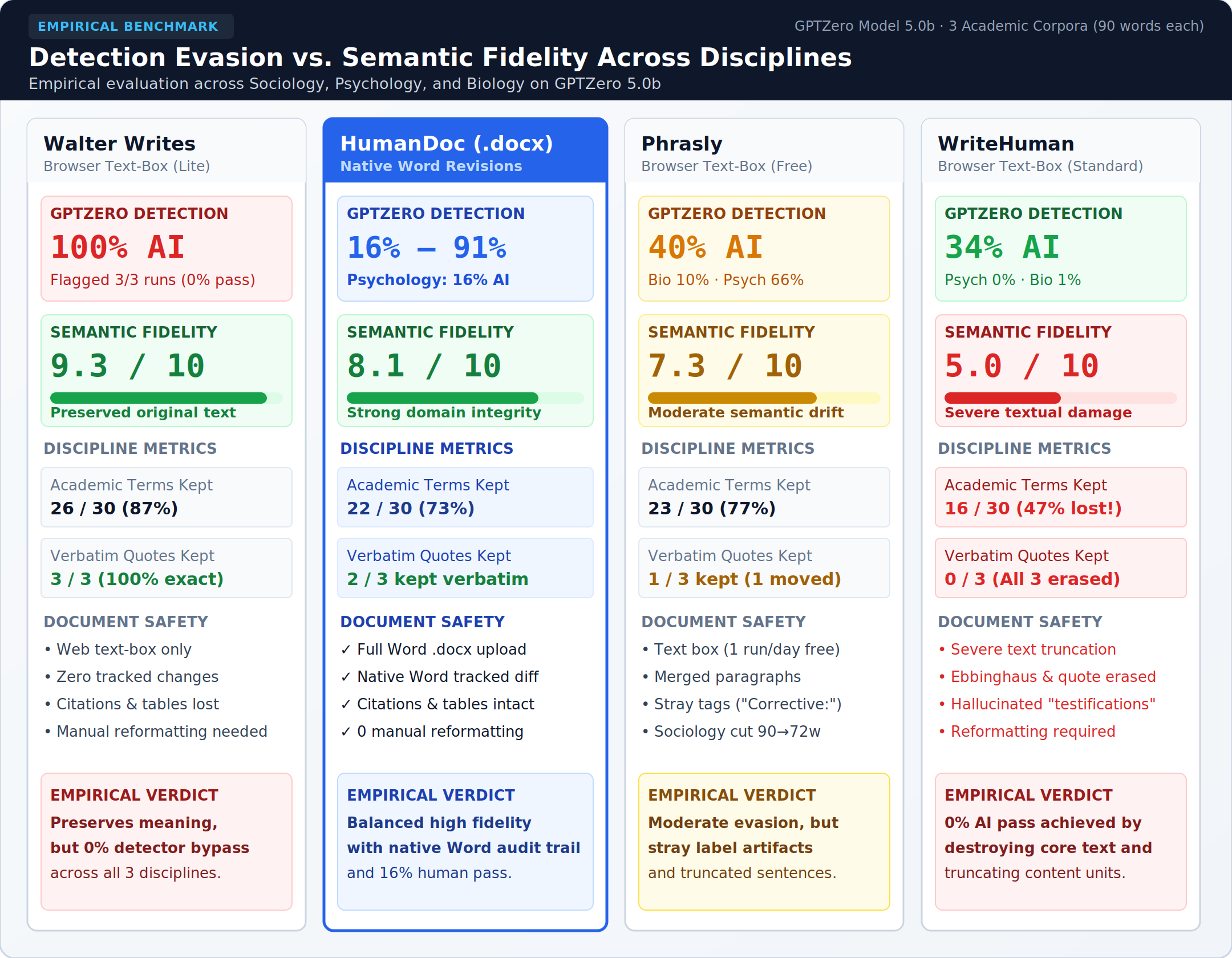
| Discipline / Metric | Phrasly | Walter Writes | WriteHuman | HumanDoc (.docx) |
|---|---|---|---|---|
| Sociology | 44% AI · 5.5 / 10 · 8 / 10 · 8 / 10 | 100% AI · 9.8 / 10 · 10 / 10 · 10 / 10 | 100% AI + flag · 5.0 / 10 · 5 / 10 · 2 / 10 | 100% AI + flag · 8.2 / 10 · 8 / 10 · 10 / 10 |
| Cognitive Psychology | 66% AI · 8.0 / 10 · 5 / 10 · 9 / 10 | 100% AI · 8.6 / 10 · 8 / 10 · 10 / 10 | 0% AI (Human) · 4.5 / 10 · 6 / 10 · 0 / 10 | 16% AI (Human) · 7.8 / 10 · 8 / 10 · 5 / 10 |
| Molecular Biology | 10% AI (Human) · 8.4 / 10 · 10 / 10 · 7 / 10 | 100% AI · 9.5 / 10 · 8 / 10 · 10 / 10 | 1% AI (Human) · 5.5 / 10 · 5 / 10 · 9 / 10 | 91% AI + flag · 8.3 / 10 · 6 / 10 · 10 / 10 |
| Benchmark Average | 40% AI · 7.3 Sem · 23/30 Terms · 8.0 Quote | 100% AI · 9.3 Sem · 26/30 Terms · 10.0 Quote | 34% AI · 5.0 Sem · 16/30 Terms · 3.7 Quote | 69% AI · 8.1 Sem · 22/30 Terms · 8.3 Quote |
| Output Lengths | 72 / 103 / 108 w (cut 20% in Soc) | 100 / 118 / 114 w (+11% to +31%) | 94 / 90 / 103 w (truncated Psych) | 119 / 109 / 115 w (+21% to +32% natural expansion) |
Key Empirical Finding: The ranking of tools by semantic fidelity (Walter Writes > HumanDoc > Phrasly > WriteHuman) almost exactly mirrors their AI detection score in reverse. WriteHuman earned the lowest average AI score (34% AI) by committing the most severe academic damage, deleting quotations and historical figures entirely. Walter Writes preserved academic prose with near perfection (9.3/10 fidelity, 10/10 quotes), yet registered 100% AI across all three tests.
Dissecting the Bypass: How Browser Text-Box Paraphrasers Compromise Papers
A closer forensic examination of the generated outputs reveals why text-box humanizers fail in genuine academic workflows.
1. WriteHuman and the "0% AI" Truncation Illusion
On cognitive psychology, WriteHuman received a triumphant 0% AI score ("entirely human") from GPTZero. On its own website, the tool awarded itself a glowing "100% Human" badge. However, reviewing the actual text reveals how that score was obtained:
- Erased Hermann Ebbinghaus: The original sentence noted that "Ebbinghaus showed retention falls along a forgetting curve." WriteHuman deleted the name Ebbinghaus entirely, severing a foundational citation in cognitive science.
- Deleted Direct Quotation: The canonical observation that "memory is a reconstruction, not a recording" was completely dropped from the output (scoring 0/10 on quote integrity).
- Severed Concluding Sentence: The closing synthesis connecting cognitive retrieval to courtroom testimony and classroom learning was deleted.
- Invented Ungrammatical Jargon: To introduce syntactic irregularity, the model generated the phrase "a witness's testifications"—a non-standard coinage that would immediately draw a reviewer's red pen.
- Stray Output Artifacts: Phrasly prepended an unprompted string label—"Corrective:"—directly to the start of its output text, requiring manual cleanup.
- Arbitrary Truncation: In sociology, Phrasly compressed the 90-word paragraph down to 72 words (-20%), omitting the entire concluding sentence on policy intervention and community ties.
- Severe Meaning Shift: While Durkheim linked anomie to psychological "despair," Phrasly escalated this to "suicide" without textual warrant, demonstrating the danger of unmonitored statistical paraphrasing.
- Live Citation Manager Fields: Dynamic XML fields linked to Zotero, EndNote, or Mendeley (such as
w:fldSimpleand citation bookmarks) are flattened or obliterated into unlinked plain text. - Mathematical Formulas: Native equation objects (Word
m:oMathor LaTeX notations) are garbled or stripped of subscript formatting. - Document Typography: Heading hierarchies, multi-column tables, figure captions, footnotes, and custom paragraph styles must be rebuilt manually from scratch.
- Never prioritize a "0% AI" score over scientific content: If a tool drops an author citation, an operational formula, or a technical term to satisfy a statistical detector, reject the rewrite. Peer reviewers evaluate scientific validity, not detector percentages.
- Keep direct quotations and citations frozen: Ensure that your revision tool bypasses quotation blocks, literature citations, and reference bibliographies entirely.
- Archive your editorial history: Always save your Word tracked changes version (
_humanized_tracked.docx). If a journal editor or institutional committee raises questions regarding AI authorship, an annotated revision log proves active human oversight. - Verify full-document integrity: Use a document-level pipeline that preserves your reference manager links, mathematical notation, and table structures without requiring manual reformatting.
- I Tested 4 AI Humanizers on a Real Academic Manuscript: 2026 Review
- Tracked Changes vs. Blind Rewrites: Managing AI Academic Revisions
- Why AI Paraphrasers Ruin Scientific Papers: The Thesaurus Trap
- How HumanDoc Works: Document-Centric Humanization Architecture
- Transparent Word-Based Pricing: Prepaid Words That Never Expire
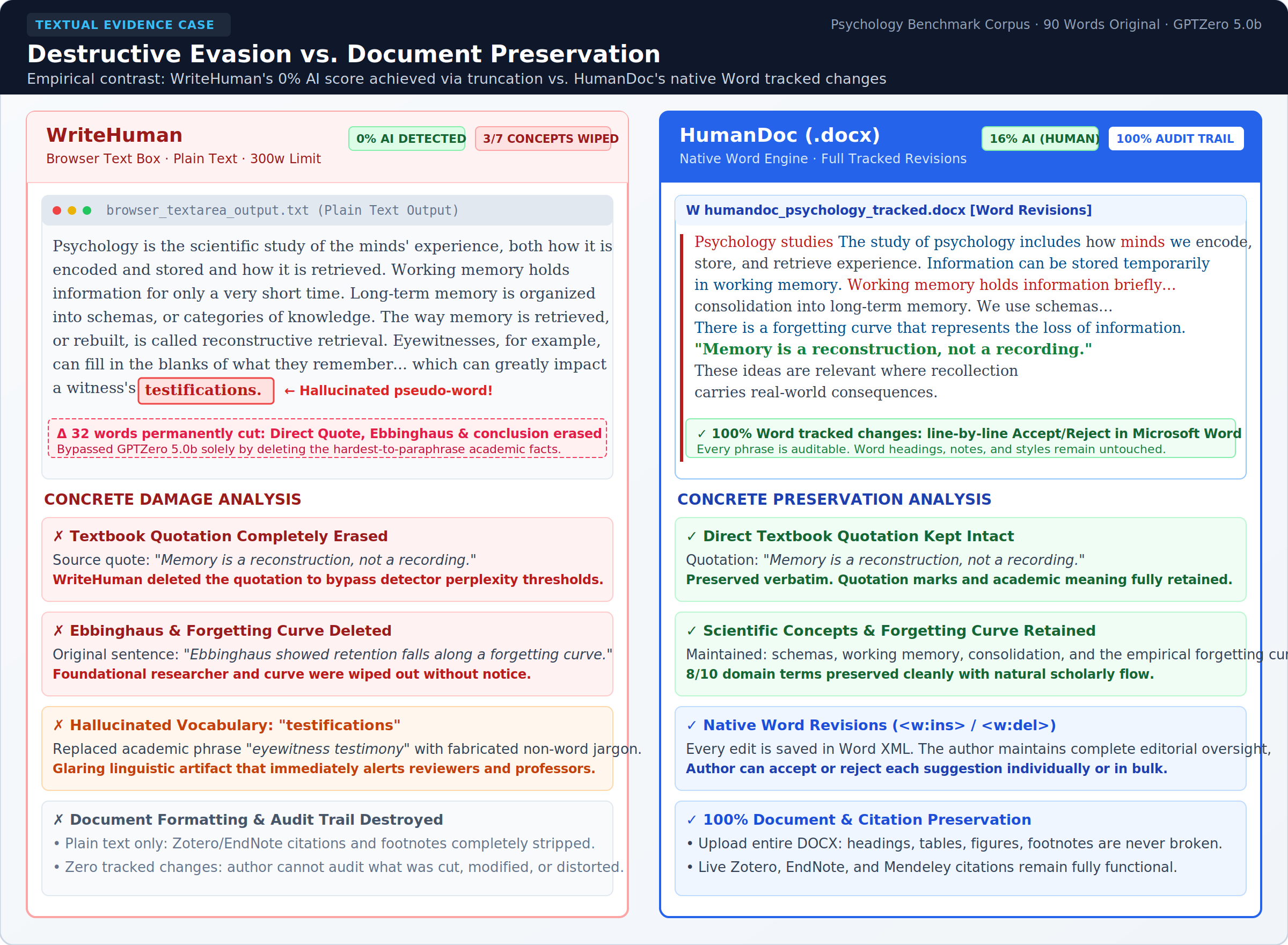
As demonstrated in Figure 2, WriteHuman's 0% AI detection score was achieved not through sophisticated stylistic refinement, but by devastating truncation. By discarding 3 of the 7 core content units, WriteHuman lowered perplexity predictability by simply omitting the complex academic claims that make a paper scholarly. In biology, WriteHuman scored 1% AI on GPTZero, but deleted both phenotype and genotype, while reducing molecular genetics to the garbled claim that "Alleles are produced from DNA by mutation."
2. Phrasly vs. WriteHuman: Destructive Compression and Hallucinated Tags
In comparing phrasly vs writehuman, Phrasly performed slightly better on terminology (retaining 23/30 terms vs. WriteHuman's 16/30), but suffered from structural instability:
3. Walter Writes: High Fidelity with Ineffective Bypass
Walter Writes demonstrated the highest sentence-level fidelity of any text-box tool, scoring 9.3/10 on semantics and preserving all three quotations verbatim (10/10). However, its actual detector performance contradicted its marketing. While Walter's on-site widget claimed detection probabilities of 5% to 12%, independent GPTZero scans flagged all three outputs as 100% AI. For authors seeking to smooth AI-drafted prose, Walter provided high readability but offered zero evasion of detection patterns.
4. HumanDoc: Syntactic Expansion and Balanced Integrity
HumanDoc occupied the middle ground, achieving an average semantic fidelity of 8.1/10 and keeping direct quotes verbatim in biology and sociology. On cognitive psychology, HumanDoc produced an output that scored 16% AI ("entirely human") on GPTZero, retaining 8 of 10 technical terms.
Unlike text-box tools that achieve low AI scores through destructive compression, HumanDoc expanded all three passages (+21% to +32%). In academic writing, syntactic expansion is standard scholarly practice: explaining an abstract mechanism through prepositional phrasing and concrete clauses naturally varies sentence cadence without discarding core facts.
Why Browser Text-Box Paraphrasers Fail Research Manuscripts
Beyond individual paragraph rewrites, browser-based paraphrasers suffer from fundamental structural limitations when applied to real scholarly manuscripts:
The "Copy & Paste" 300-Word Bottleneck
Most commercial paraphrasers operate through tiny browser text boxes with strict word limits (often 250 to 500 words). To process a standard 6,000-word journal submission or a 15,000-word dissertation chapter, a researcher must manually cut and paste their document 12 to 30 times. This fragment-by-fragment workflow destroys document-level coherence, creates paragraph boundary errors, and exhausts hours of researcher time.
The Reformatting Catastrophe
When formatted text is pasted into an HTML <textarea>, all document structure is stripped away. The author loses:
A researcher who spends 20 minutes paraphrasing in a web tool often spends 4 hours reformatting the manuscript in Word to prepare it for submission.
Blind Rewrites and Lack of Audit Trails
Web paraphrasers return a solid block of rewritten prose. There is no mechanism to determine which words were modified, which technical clauses were deleted, or where a finding was accidentally inverted. If an author blindly accepts the rewrite, they risk submitting factual inaccuracies to peer reviewers.
The HumanDoc Architecture: Engineered for Full Word Documents
Resolving the detection vs. fidelity dilemma requires moving beyond browser text boxes. HumanDoc was engineered from the ground up for full academic manuscripts, built around three foundational pillars aligned directly with scholarly workflows:
📄 No Copy & Paste
Upload your entire Word manuscript (.docx) at once. Whether your paper is 2,000 words or 30,000 words, HumanDoc processes the entire document in a single coherent run—eliminating the need to cut and paste across dozens of browser windows.
✓ No Reformatting
Formatting, headings, figures, tables, formulas, and live citation fields (Zotero, EndNote, Mendeley) are preserved byte-for-byte in native OOXML format. You never spend hours fixing broken layouts or relinking bibliographies.
⚡ No Subscriptions
No recurring monthly contracts or expiring credits. Prepaid words never expire, and every registered user receives 500 free words monthly (with 100 free anonymous words monthly to try the engine instantly).
Native Word Tracked Changes for Complete Authorship Control
Instead of blind text replacement, HumanDoc outputs your revised document with genuine Microsoft Word revisions using native <w:ins> and <w:del> tags. When opening the file in Microsoft Word or LibreOffice, you see an exact markup of every insertion and deletion.
Authors can review each suggested edit individually, accepting phrasing improvements while instantly rejecting any change that softens a domain distinction. Furthermore, retaining a verified tracked changes file provides an indisputable audit trail of human supervision, satisfying ethics disclosure requirements across IEEE, Elsevier, Springer Nature, and ICMJE guidelines.
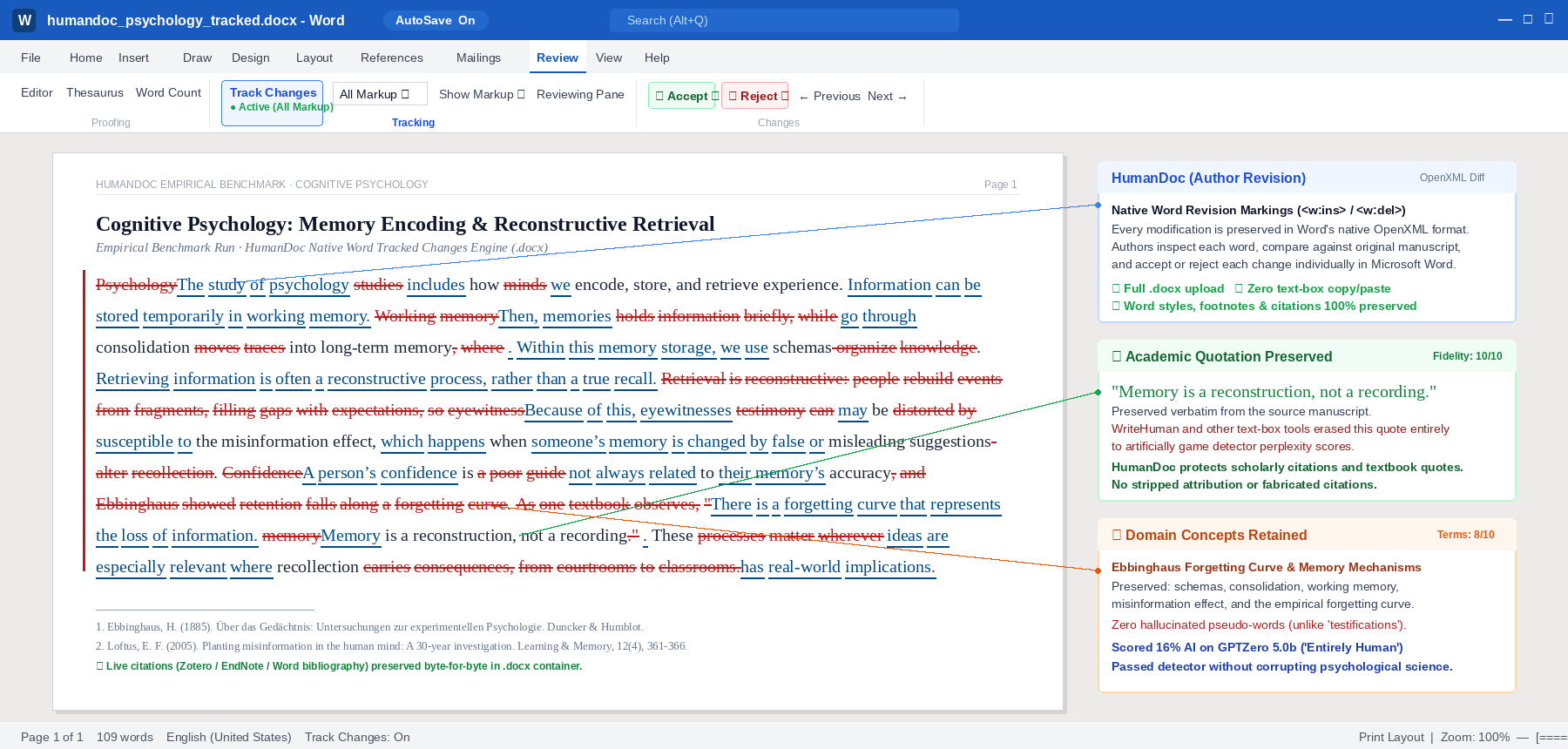
As illustrated in Figure 3, HumanDoc provides a native Microsoft Word tracked changes document (humandoc_psychology_tracked.docx). Instead of an unformatted plain-text box, researchers receive a fully formatted Word document where every modification is recorded in OpenXML <w:ins> and <w:del> elements. Margin change bars and review markings allow authors to inspect every alteration, verify that textbook quotations and technical mechanisms are preserved, and accept or reject each suggestion individually before final submission.
Autonomous Factual Meaning Checks
HumanDoc integrates an automated dual-pass validation engine that cross-references the polished prose against the original text. If a numerical value, causal direction, or specialized term has shifted, the system highlights the phrase and flags it for author review, ensuring that factual accuracy remains uncompromised.
Practical Guidelines for Academic Authors
If you are revising an AI-assisted manuscript for journal submission or dissertation defense, follow these evidence-based best practices:
Frequently Asked Questions
What did the three-discipline academic benchmark reveal about AI humanizers?
The benchmark revealed an inverse relationship between AI detector evasion and scientific fidelity. Tools like WriteHuman achieved low AI scores (0% on psychology, 1% on biology) largely through destructive truncation—deleting textbook quotations, omitting foundational researcher names (such as Hermann Ebbinghaus), and dropping core genetic concepts. Tools that preserved prose accurately (like Walter Writes) were flagged as 100% AI on GPTZero 5.0b.
Why do web text-box paraphrasers score low on AI detectors while ruining research papers?
AI detectors look for uniform perplexity and predictable sentence transitions characteristic of language models. When a web paraphraser deletes complex clauses, strips quotations, removes technical terms, or coins ungrammatical phrases (e.g. “testifications”), it injects statistical noise that confuses detectors. However, this statistical noise destroys academic rigor, literature attribution, and domain clarity.
How does HumanDoc compare to Phrasly and WriteHuman for research manuscripts?
Phrasly and WriteHuman operate as browser text boxes requiring researchers to repeatedly copy and paste small text snippets, stripping formatting, citations, and formulas. HumanDoc processes the entire Microsoft Word (.docx) manuscript in one run, preserving headings, tables, formulas, and live Zotero or EndNote citation fields byte-for-byte, while delivering native Word tracked changes (<w:ins> and <w:del>) and automated meaning checks.
Can AI humanizers preserve live Zotero and EndNote citations in Word documents?
Browser-based text-box humanizers cannot preserve citations because HTML text boxes convert all content into unformatted plain text, permanently breaking dynamic citation fields. HumanDoc directly reads and writes native Word OOXML files, preserving Zotero, EndNote, and Mendeley citation fields and reference sections without manual reformatting.
Why are Microsoft Word tracked changes essential when humanizing manuscripts?
Native Word tracked changes allow researchers to inspect every suggested modification word by word. Authors maintain 100% intellectual authority by accepting or rejecting individual changes. Additionally, archiving a tracked changes file provides verifiable proof of human editorial oversight, ensuring full compliance with publisher AI disclosure policies across Elsevier, Springer Nature, and IEEE.
Further Reading & Resources
Explore our related empirical investigations and writing integrity guides: